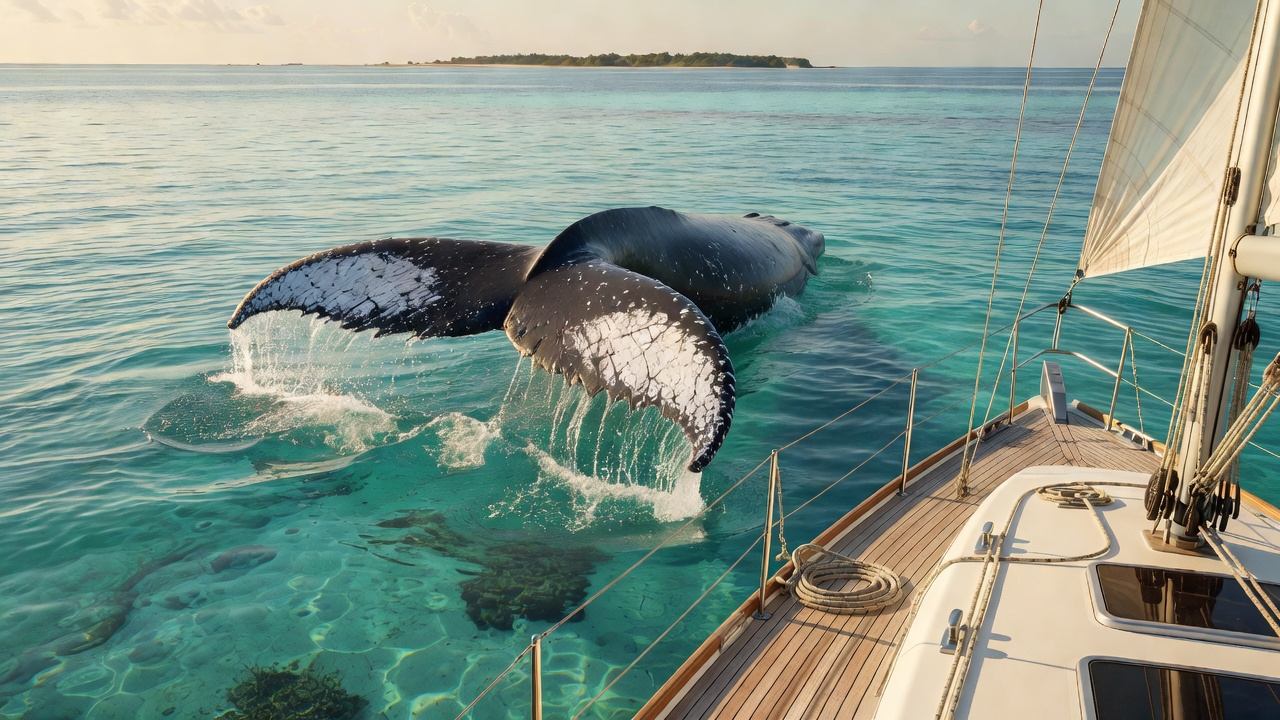
Cruisers who’ve spent the austral winter anchored in Moorea’s Cook’s Bay or moored inside Bora Bora’s lagoon have likely already noticed the season’s other visitors: humpback whales, present in French Polynesia’s waters from late July through November. The 2026 season runs July 20 through November 20, with September and October the peak viewing window — which means boats still swinging on a mooring in the Society Islands right now are anchored in some of the best humpback water in the Pacific, whether or not they came here to watch whales.
This isn’t a guide for booking a whale tour. It’s a practical note for cruisers already at anchor about what’s actually out there this time of year, and what sharing water with a 15-meter animal and her calf means for how a boat is handled.
Where the Whales Actually Are
Humpbacks migrate up from Antarctic feeding grounds in late June or early July to breed and calve in French Polynesia’s warmer waters, concentrating around Tahiti, Moorea, Bora Bora, and Rurutu in the Austral Islands. For cruisers on the standard Society Islands circuit, that means:
- Moorea — particularly the waters off Cook’s Bay and Opunohu Bay, both already familiar to anyone anchored there for the season
- Bora Bora — the lagoon and the deeper water just outside Teavanui Pass see regular humpback activity through the peak window
- Rurutu (Austral Islands) — a lesser-known but well-regarded hotspot, more remote from the standard cruising circuit but a genuine detour for anyone with time before the season closes
By late October and into November, mothers and newly strong calves begin the return migration south to Antarctic waters, which is why the season closes on November 20 rather than running year-round.
The Rules for Boats That Aren’t Whale-Watching Operators
French Polynesia regulates whale encounters closely, and the rules that apply to a private cruising yacht are noticeably stricter than the ones that apply to a licensed tour operator — a distinction worth knowing before assuming a closer approach is fine because a tour boat nearby is doing it.
For private vessels (this includes cruising yachts):
- Maintain at least 300 meters of separation from any whale
- Reduce speed to 3 knots within that 300-meter radius
- No swimming with or approaching whales in the water — in-water encounters are restricted to operators certified by DIREN (French Polynesia’s environment authority), under their own separate and tighter distance rules
For certified whale-watching operators, the approach distance drops to 100 meters by boat and 15 meters for a swimmer in the water, with swim groups capped at six people — allowances specifically granted to permitted operators, not to passing cruising boats, regardless of how calm the encounter looks.
Practically, this means a cruiser under sail or motoring near a whale sighting should hold well back and let the animal set the distance, rather than treating a humpback sighting from the cockpit as an invitation to close in for a better look or a photo.
Anchoring and Mooring With Whales Nearby
Neither Moorea’s nor Bora Bora’s anchorages are closed to boats during whale season, and there’s no special anchoring restriction tied to whale presence in either location. What changes is situational awareness:
- Watch for blows and surface activity before motoring through open water, particularly at dawn and dusk when whales are often more active near the surface and visibility for both boat and animal is reduced.
- A resting mother-and-calf pair may sit still on the surface for extended periods. Don’t assume a stationary shape is a mooring buoy or debris — reduce speed and go wide around anything ambiguous on the water in whale season.
- Dinghy traffic between the anchorage and shore is where most close encounters actually happen, not the main boat — the same 300-meter guidance applies to a dinghy as it does to the yacht itself, and a small outboard-powered tender has less margin to react than a full-sized vessel.
Watching From the Boat, Responsibly
None of this means whale season is something to avoid — being anchored in Moorea or Bora Bora through September and October puts a cruiser in one of the more reliable places on Earth to see humpbacks from their own deck, at no cost and with no tour to book. A pair of binoculars, a bit of patience at anchor in the late afternoon, and attention to the horizon during a normal watch are enough to catch blows, breaches, and tail slaps without ever closing the required distance.
For anyone wanting a closer, in-water encounter within the actual rules, booking with a DIREN-certified operator is the only way to legally do it — a private yacht cannot substitute its own dinghy for a licensed tour boat’s permit, no matter how experienced the crew.
Frequently Asked Questions
Is whale season the same every year?
The general window — roughly late June/July through November — repeats annually as part of the humpback migration cycle, though the exact start and close dates for the “official” season can shift slightly year to year. Check the current season’s dates locally (dive operators and the DIREN website are common sources) rather than assuming last year’s dates apply exactly.
Can we hear whales through the hull at anchor?
Many cruisers anchored in Moorea and Bora Bora during peak season report hearing whale song faintly through the hull, particularly at night in calm conditions — a genuinely memorable, if unplanned, part of an austral-winter stay in the Society Islands.
What should we do if a whale approaches our boat?
Reduce speed to idle or stop if safely possible, and let the animal move away on its own terms rather than maneuvering to follow or reposition for a better view. The 300-meter rule is a minimum standard to maintain, not a target distance to close toward.
Does whale season affect anchorage availability in Moorea or Bora Bora?
Not directly — anchoring and mooring availability follows the same seasonal cruiser traffic patterns covered in our Bora Bora sailing guide, independent of whale presence.